The Best Travel Camera in 2026? 5 Reasons I Love the Fujifilm X100VI
If you’re looking for the best travel camera in 2026, there are plenty of options to choose from. But after years of travelling with different cameras and camera gear, there’s one I keep coming back to: the Fujifilm X100VI.
I initially wasn’t interested in the X100VI. In fact, I was pretty sceptical about why I needed one.
After borrowing one from a friend and eventually buying one myself, I started to understand the appeal.
After travelling with it for the past year, I think the X100VI is one of the best cameras you can buy for travel photography.
Here are five reasons why.

Algarve, Portugal
1. It's great for beginners and professionals
One of the biggest strengths of the Fujifilm X100VI is its versatility.
You don't have to be a professional photographer to get great results from it. If you're going on holiday and want better photos of your trip, your friends and family or simply want to create a photo book of your travels, the X100VI can give your images a more polished look.
It has a 23mm f/2 lens, equivalent to 35mm on a full-frame camera. That makes it a really useful focal length for travel photography.
It's wide enough for landscapes and environmental shots but still tight enough for portraits and everyday street photography.
The f/2 aperture also gives you plenty of light and allows you to create a shallow depth of field and that lovely background blur photographers call bokeh.
For professionals, it works brilliantly as a second camera.
You might have your main professional setup with you but don't necessarily want to carry it everywhere. If you're heading out for a coffee, exploring a new city or going on a day trip, the X100VI is small enough to take with you without feeling like you're carrying your entire camera bag.
And that's important.
The best travel camera isn't necessarily the one with the most features. It's the one you're actually willing to take with you.
2. Fujifilm film simulations and recipes are brilliant
One of my favourite things about Fujifilm cameras is the ability to create and use film simulations and custom JPEG recipes.
This is particularly useful when travelling because you can get photographs that already have a look you love straight out of the camera.
No Lightroom. No hours of editing. No sitting in front of your computer after a holiday trying to process hundreds of RAW files.
You can simply shoot, transfer your JPEGs and use them.
I've even created my own Fujifilm recipe which has had almost 100,000 views on YouTube. There are also countless other recipes available to experiment with and you can tweak them to create something that suits your own style.
You can still shoot RAW if you want the flexibility of editing your photographs later.
But for travel photography, being able to get great-looking JPEGs straight out of the camera is a huge advantage.
It's one of the reasons I keep coming back to Fujifilm.

Valletta, Malta
3. It's surprisingly good for video
The X100VI isn't just a stills camera.
If you're someone who likes to take photographs and shoot video while travelling, it can make a surprisingly capable little hybrid camera.
The ability to use Fujifilm's looks for video means you can create photographs and video that feel consistent with one another.
That's particularly useful if you're making a travel montage, holiday film or simply documenting your trip.
The X100VI also has in-body image stabilisation (IBIS) which makes handheld video much more usable.
I've shot plenty of handheld footage with it and been surprised by how stable it can look.
The fixed 35mm-equivalent lens is obviously a limitation. You don't have the flexibility of changing focal lengths like you would with an interchangeable-lens camera.
But for me, 35mm is a sweet spot.
It's wide enough for most travel situations while still giving you enough compression for people, details and street photography.
4. The articulating screen makes street photography easier
This is something I initially underestimated.
The X100VI's articulating screen is incredibly useful when you're travelling, particularly for street photography.
You can shoot from the hip without having to bring the camera up to your eye.
That means you can be more discreet when photographing in public spaces.
I'm naturally quite introverted when shooting on the street, so I don't always want to draw attention to myself by putting a camera up to my face.
The articulating screen lets you shoot from a lower position while still being able to see what you're photographing.
It's also useful for video.
If you're filming yourself or simply want to shoot handheld footage without holding the camera up to your eye, the screen makes things much more comfortable.
The X100VI isn't quite as discreet as something like the Ricoh GR III series, but it's still a relatively unobtrusive camera.
And when you're travelling, that matters.
5. The optical viewfinder and built-in flash
The final reason is actually two features I really appreciate.
The optical viewfinder
The X100VI has an optical viewfinder (OVF) which gives it a very different shooting experience from most modern mirrorless cameras.
You can see your scene through the optical viewfinder while also seeing what's happening just outside your frame.
That can be incredibly useful for street photography.
Instead of only seeing what's inside the frame, you can see what's about to enter it.
It also gives the camera a more traditional, almost analogue feeling.
If you enjoy the experience of shooting film cameras, the OVF is one of the features that makes the X100VI particularly enjoyable to use.
The built-in flash
The built-in flash is another feature that's easy to forget about.
I don't use it all the time, but when you do need it, it's there.
It can be particularly useful for nightlife, parties, festivals or situations where you want a more direct flash photography look.
It's not necessarily the reason I'd buy the camera, but it's a nice feature to have.
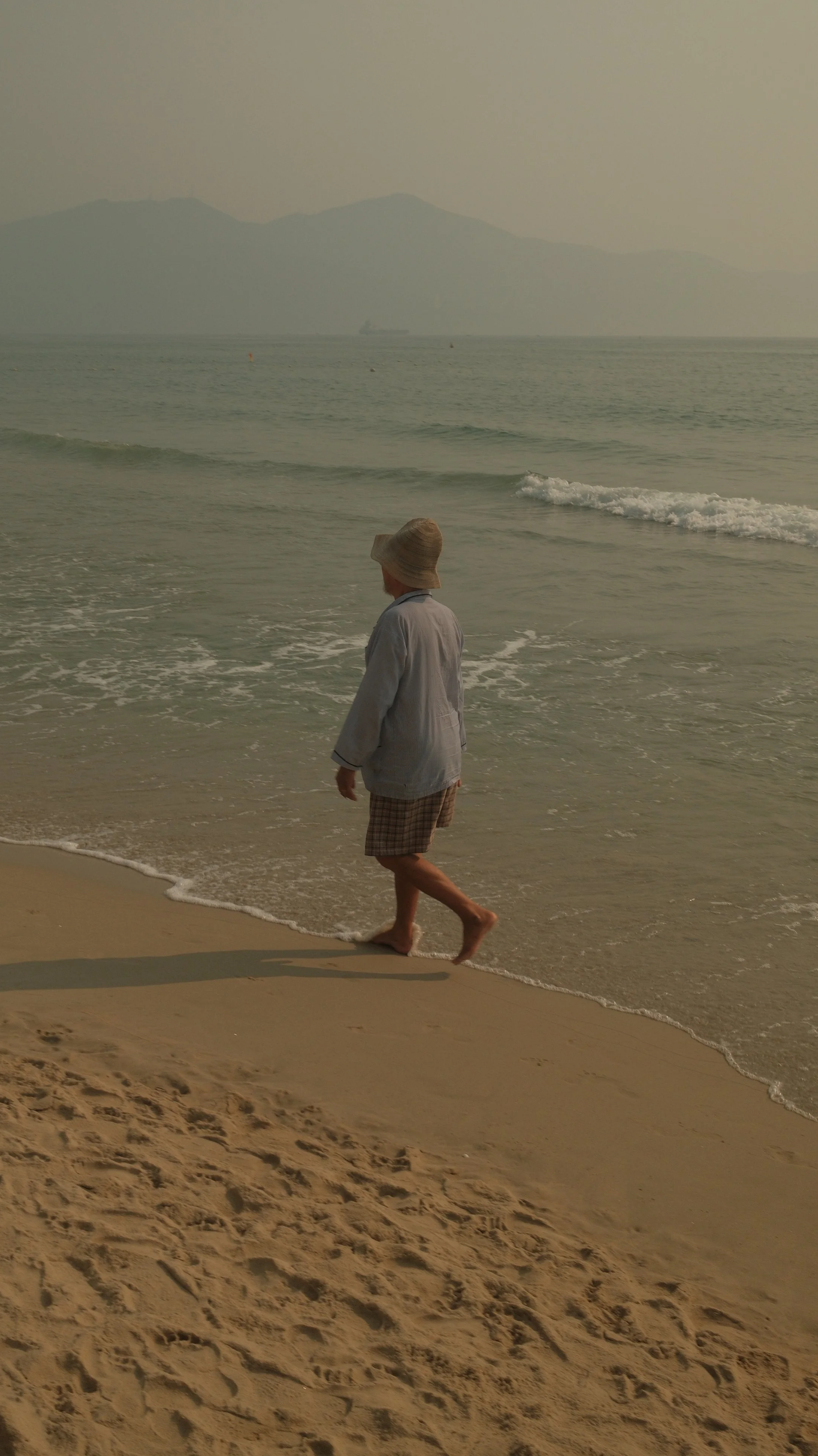
Da Nang, Vietnam
The downsides of the Fujifilm X100VI
The X100VI isn't perfect.
The biggest issue is the price.
If you're a beginner or you're working with a limited budget, I'd think carefully before spending this much money on a camera.
I bought mine second-hand for around £1,500 which made more sense to me financially. Buying used is definitely worth considering if you're interested in one.
The other major downside is battery life.
It's not particularly impressive, especially if you're shooting a lot of video. I'd recommend carrying at least one spare battery when travelling.
Cold weather can make this even more noticeable. I experienced this myself while shooting in Ireland and found the battery drained much faster than usual.
There's also only one SD card slot.
For professional photographers who need an immediate backup of every photograph, that could be a deal-breaker.
Personally, I don't use the X100VI as my main professional camera, so it doesn't bother me too much. My Sony and Fujifilm X-H2S are the cameras I'd reach for when I need a more serious professional setup.
Is the Fujifilm X100VI the best travel camera?
For me, yes.
That doesn't mean it's objectively the best camera for everyone.
If you need interchangeable lenses, long focal lengths, professional dual-card backup or a much cheaper camera, there are better options.
But if you want a relatively compact camera that produces beautiful photographs, shoots good video, has excellent JPEG colour, works brilliantly for street photography and is enjoyable to carry around, the Fujifilm X100VI is one of the best travel cameras available in 2026.
And ultimately, that's what matters to me.
I take it everywhere.
It comes with me on bigger trips but also on little day trips around the UK. Sometimes I'll just take it when I'm going to see friends or family.
Because when you have a camera that you genuinely enjoy carrying, you're much more likely to actually use it.
And that's worth more than another camera sitting at home because it's too big, too heavy or too complicated to take with you.
"As an Amazon Associate I earn from qualifying purchases."